Critical texts
In the Secret Gathering of Silent Colors and Lines
Yasunori Sakakibara: A Long, Quiet, Meditative Journey Through Light, Shadow, Memory, and Multicultural Worlds
Writing about Yasunori Sakakibara means stepping into a vast, multilayered continent—one that holds history, migration, shifting borders, and, beyond those borders, a free and inward-looking individual consciousness. His life is a complex diaspora of light and shadow—born in Japan, educated in Tokyo’s art institutions, his artistic presence spanning Southeast Asia and India, and his spiritual depth shaped by the multi-colonial history of Guam. To understand him is to read a multidirectional map whose lines are never straight—they break, bend, merge, and form entirely new worlds. Sakakibara is never a painter of a single nation or a single lineage; he is an ever-moving traveler—one who can hold in a single canvas the face of every city, the light of every land, the ghosts of every history, and the invisible restlessness of human beings.
He was born in 1967 in the quiet middle region of Aichi Prefecture. Small Japanese towns like these possess a certain stillness—a kind of silent presence that teaches people how to contemplate. His childhood, therefore, was restrained, contained, quiet—and yet invisibly artistic. He often admits that people sometimes realize their artistic birth much later in life, even though the first light had arrived long before. In his case, that first light was music. At fourteen, a friend played him Isao Tomita’s legendary album Snowflakes Are Dancing. It was not merely an album—it was an acoustic visual composition, where sound itself became image, light, air, and wonder. Critics had called it “tone painting,” and that phrase stirred something deep within Sakakibara. He realized that invisible scenes could be art, that a scene not present on canvas could still exist in sound, in the mind, in darkness and light. This realization stayed inside him like a seed. The central current of his later work grew out of that single awakening.
Then came the years at Tama Art University—where he graduated in oil painting in 1992. The path he began to walk was a dialogue with tradition on one side, and a confrontation with his own inner questions on the other. Tokyo—with its speed, discipline, and immense urban machinery—could not stop him from searching for the contemplative slowness of older painting traditions. He immersed himself in the hyper-observational detail of the Northern Renaissance—Dürer’s miraculous lines, Grünewald’s tragic intensity, Jan van Eyck’s intricate architecture of light. Many Japanese art students are fascinated by Western art, but for Sakakibara it was different. He was not merely drawn to it—he studied, experimented, and mastered the slow, layered techniques of Renaissance oil: from egg tempera to the patient, multi-layered breathing of glazing. This technique created in his works a bottomless illumination—one that suggests there is always another scene hidden beneath the scene, another world inside the shadows.
At the same time, another world was shaping him—the Buddhist painting traditions of Japan, especially from the 10th to 12th centuries. In these works he found not the depth of color but the depth of the soul. The attraction of Buddhist painting for him was its connection between spirituality and color, between light and silence. He realized that art is not merely about visibility, it is a path carrying the human desire to transcend. This would become the structural philosophy behind his later years.
Another layer formed through the cinema of Akira Kurosawa. Kurosawa’s use of shadow, narrative gravity, and the transformation of human crisis into something epic taught him how to expand art into larger worlds of thought. Sakakibara understood that just like light and darkness, human conflict itself is an artistic form—fear, indecision, weakness—all of it can become a canvas.
The blending of Japanese and Western traditions rooted itself within him, but his true transformation happened through his travels across Asia. In 1997, a contemporary Asian art exhibition in Tokyo revealed to him that Asia is not merely tradition—it is multiplicity, upheaval, shifting urban energies. This understanding pulled him toward Thailand, then India, Nepal, Hong Kong, Taiwan, and Indonesia. In each country he observed different anchors of human belief—religious in some places, social in others, and in some simply the desire to protect daily life. The colors, lights, and shadows of these countries formed new layers in his work.
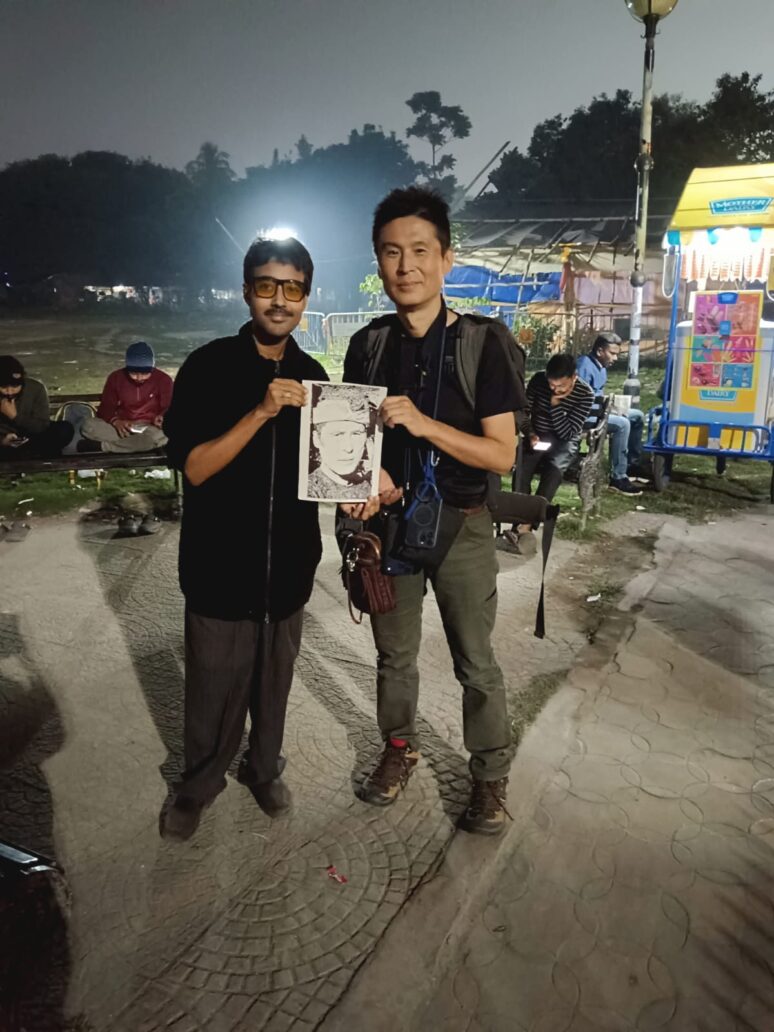
But India—especially Kolkata—became for him a deep emotional experience. He saw Kolkata as a multidimensional labyrinth: colonial memory, contemporary poverty, vibrant crowds, and multiple streams of history coexisting in a strange, dense complexity. His images of Kolkata contain temporal layers—light and shadow merging with memory, fear, anguish, and the resilient vitality of the city. For him, Kolkata is not merely a city, but a breath, a burning, a silent document.
These travels crystallized in him a belief that borders never define identity; rather, humans create the meaning of borders. This philosophy became even sharper during his time in Guam. From 2013 to 2015 he lived there—a place marked by colonial tension, Spanish-American-Japanese occupation, the scars of war, racial complexity, and political contradictions. Here he witnessed how people carry historical violence inside them—and also how they weave it into their everyday life. The artists of Guam taught him that art is also a method of bearing pain. And it was here that he recognized with greater clarity that national or ethnic identity can never define an artist’s identity. An artist is someone who listens to the questions inside human beings—questions without language, without nation, without borders.
Guam gave him a deeper understanding of multiculturalism and multivocality. He held exhibitions there, and in 2016 became the only Japanese artist at the Pacific Arts and Crafts Festival. Standing among artists from diverse cultures, he realized that his work carries Eastern quietude, Renaissance light, and Asian vibrancy all at once. A local artist told him, “Your paintings contain the essence of the East,” and this reaffirmed for him that his art represents not East or West but a new human continent.
Then came COVID-19—a time of isolation, identity crisis, and a world in confinement. Sakakibara turned back toward his roots—toward Buddhist philosophy. He realized that human beings ultimately live for freedom. Modern Japanese society—with its demand for conformity, collective decisions, competition, and constant adjustment—often restricts individual consciousness. As an artist, he felt responsible for guiding people toward the quiet freedom that exists within them. His art became a hidden path to that freedom.
Understanding an artist’s life is always difficult, but with Sakakibara it is even more complex, because both his work and life are multilayered, multilingual, and multi-worldly. Though he lives in Japan, his universe does not remain confined there. His paintings embody a meditative solemnity inherited from Buddhist art. Opposite this silence exists the frantic world of cities—layers of light and shadow, buildings, broken walls, alleys, and voiceless crowds. His work is shaped by Tokyo, Thailand, Guam, Kolkata—together forming a world where no image is one-dimensional. Everything holds multiple voices. Each canvas is like a pan-focused scene—no center, no margin, everything equally important.
His urban landscapes are never merely cities—they are mythologies born from cities. His Kolkata series, Guam series, Thai markets, or the natural world of Japan—they all converge into one vast frame, speaking in many voices, radiating many kinds of light.
Sakakibara says, “I want to create work that carries the weight of the world, work that gives people strength.” The weight in his paintings is not merely the layering of pigments—it is the layering of time: human memory, urban atmosphere, historical pressure, and the human desire for liberation.
Many of his paintings lack human faces—yet the human presence is overwhelming. Fear, loneliness, joy, memory—these are spread across the cities he paints. When he paints a city, he is really painting human psychology: how restless we are, how insecure, and yet how resilient. Even when he paints nature, civilization’s shadow is present. Even when he paints Buddhist motifs, they are not religious—they are existential.
His recognitions—Tokai TV Award, Tomita Award, two Silver Prizes at the Daiō Taishō exhibitions, and the Grand Prize at Creative Hands in Guam—are perhaps external achievements. His works are held in museums and civic collections in Okazaki, Shima City’s Daio Town, Toyokawa City Hall, and Guam. Yet in conversation, it becomes clear that awards do not influence him much. He often says his goal is “time-transcending work”—paintings that will stand even a hundred years from now, unaffected by changing trends or new technologies.
In contemporary Japanese art, he is a rare name—someone who weaves together the quiet gravity of Japanese aesthetics, the glow of Renaissance technique, the vibrant colors of South Asia, and the human quest for liberation. His work exists both inside and outside history—bearing weight, yet reaching toward light.
His greatest strength is his ability to see many worlds at once. His paintings hold the sea-scarred stones of Guam, the old lampposts of Kolkata, the light of the Renaissance, and the noise of Tokyo. Together they create a world where viewers may walk freely—with their own memories, their own restlessness, their own solitude and strength.
After speaking with him, one realizes that while many artists create art from their personal lives, Sakakibara creates art from the worlds he has seen—the cities he has traveled through, the music he has heard, the film frames that shaped him, the scars of history, and the invisible stories on human faces. He is a bridge of multiple sensibilities—painting Asian life through Renaissance technique, reaching Buddhist contemplation through the chaos of modern cities. His art is ultimately a long journey—one that reveals human masks, historical wounds, the dialogue of light and shadow, and, deeper still, the unchanging human center: a silent, meditative, free self beyond all borders.
To understand him is to discover within ourselves that same multidirectional terrain of light and shadow. His art teaches us how vast the world is, how complex the human being, and how profound freedom can be—where every bend holds new light, new shadow, new questions.
G K Nath Poet, Documentary Filmmaker, Vocalist/lyricist/music composer, actor ,Kolkata
Wikimedia commons