Press
Guam THE SUNDAY POST SUNDAY, JUNE 5, 2016
The article about FESTPAC 2016 in Guam
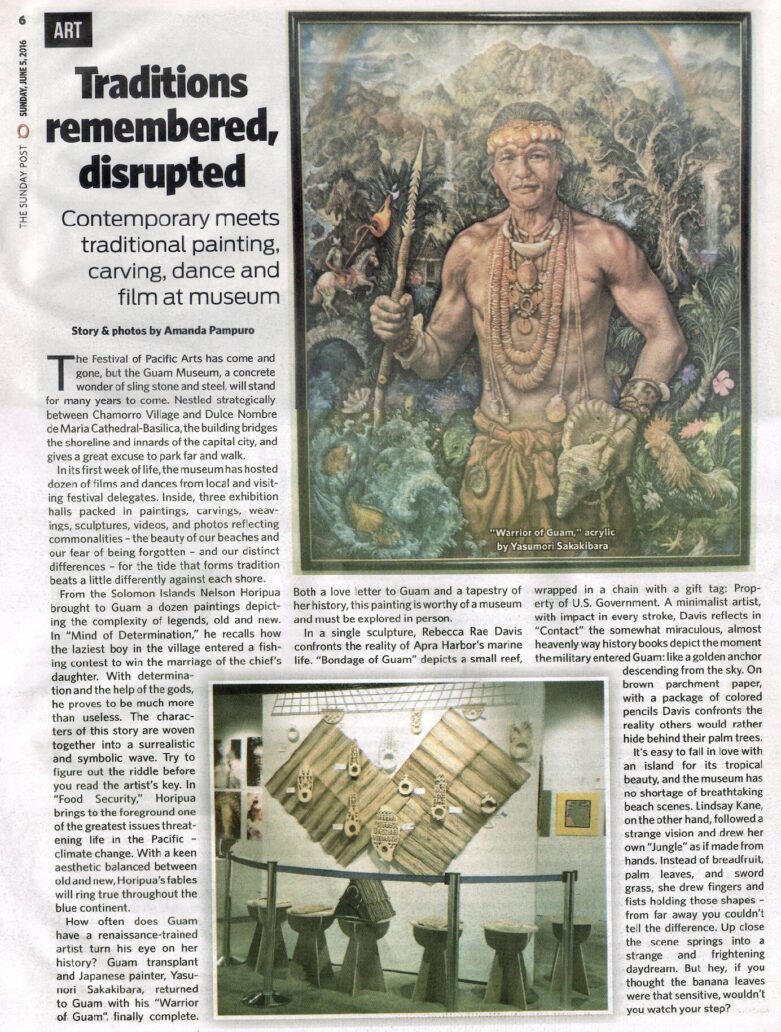
Traditions remembered, disputed
“The Festival of Pacific Arts has come and gone, but the Guam Museum, a concrete wonder of sling stone and steel, will stand for many years to come. Nestled strategically between Chamorro Village and Dulce Nombre de Maria Cathedral-Basilica, the building bridges the shoreline and innards of the capital city, and gives a great excuse to park far and walk.
In its first week of life, the museum has hosted dozen of films and dances from local and visiting festival delegates. Inside, three exhibition halls packed in paintings, carvings, weav-
ings, sculptures, videos, and photos reflecting commonalities – the beauty of our beaches and
our fear of being forgotten – and our distinct differences for the tide that forms tradition.
beats a little differently against each shore.
From the Solomon Islands Nelson Horipua brought to Guam a dozen paintings depicting the complexity of legends, old and new.
In “Mind of Determination,” he recalls how the laziest boy in the village entered a fishing contest to win the marriage of the chief’s daughter. With determination and the help of the gods, he proves to be much more than useless. The characters of this story are woven
together into a surrealistic and symbolic wave. Try to figure out the riddle before
you read the artist’s key.
In “Food Security,” Horipua brings to the foreground one of the greatest issues threatening life in the Pacific -climate change. With a keen aesthetic balanced between
old and new, Horipua’s fables I will ring true throughout the blue continent.
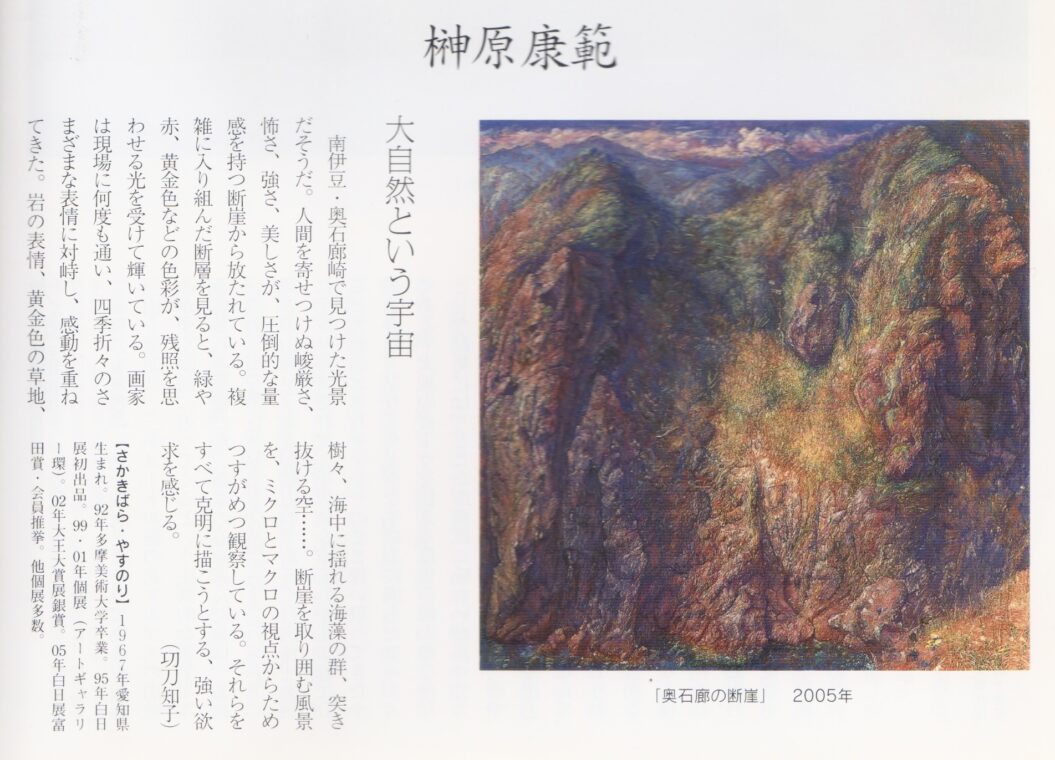
How often does Guam I have a renaissance-trained artist turn his eye on her history? Guam transplant and Japanese painter, Yasu-nori Sakakibara, returned to Guam with his “Warrior of Guam” finally complete.
“Warrior of Guam,” acrylic by Yasumori SakakibaraBoth a love letter to Guam and a tapestry of her history, this painting is worthy of a museum and must be explored in person.
In a single sculpture, Rebecca Rae Davis confronts the reality of Apra Harbor’s marine life. “Bondage of Guam” depicts a small reef, wrapped in a chain with a gift tag: Property of U.S. Government.
A minimalist artist, with impact in every stroke, Davis reflects in “Contact” the somewhat miraculous, almost heavenly way history books depict the moment the military entered Guam: like a golden anchor descending from the sky. On brown parchment paper, with a package of colored pencils Davis confronts the reality others would rather hide behind their palm trees.
It’s easy to fall in love with an island for its tropical beauty, and the museum has no shortage of breathtaking beach scenes. Lindsay Kane, on the other hand, followed a strange vision and drew her own “Jungle” as if made from hands. Instead of breadfruit, palm leaves, and sword
grass, she drew fingers and fists holding those shapes – from far away you couldn’t
tell the difference.
Up closethe scene springs into a strange and frightening daydream. But hey, if you thought the banana leaveswere that sensitive, wouldn’t
you watch your step?
Story and photos by Amanda Pampuro
Marianas Variety. 2025 about The statue of carabao, in Japanese school of Guam. painted by Yasunori Sakakibara
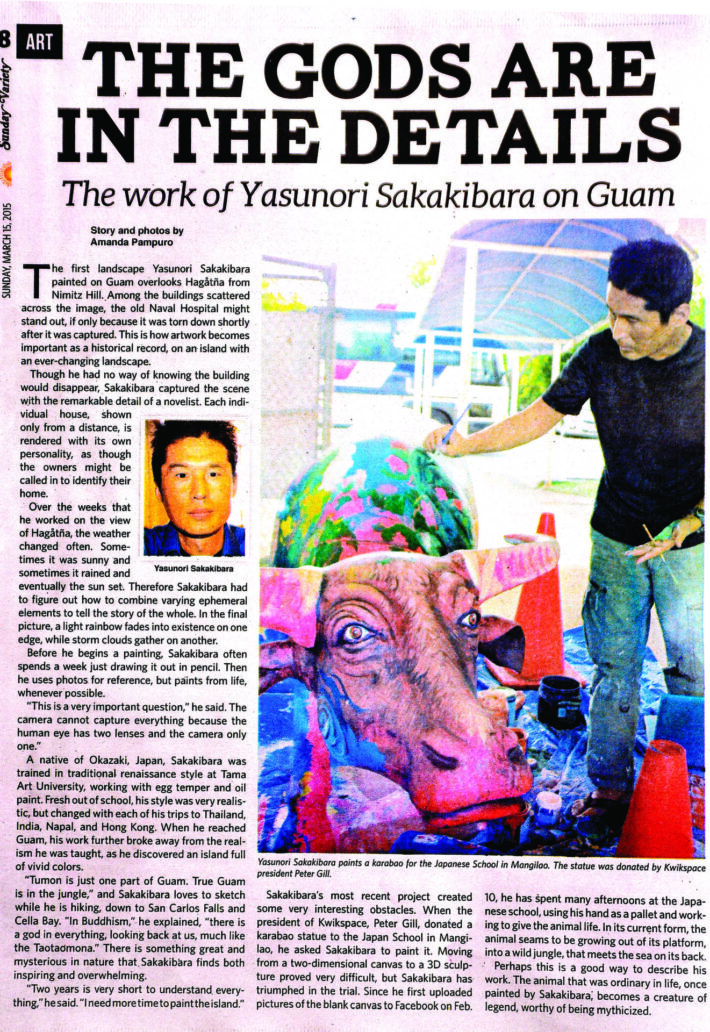
The first landscape Yasunori Sakakibara painted on Guam overlooks Hagatña from Nimitz Hill. Among the buildings scattered across the image, the old Naval Hospital might stand out, if only because it was torn down shortly after it was captured. This is how artwork becomes important as a historical record, on an island with an ever-changing landscape.
Though he had no way of knowing the building would disappear, Sakakibara captured the scene with the remarkable detail of a novelist. Each individual house, shown only from a distance, is rendered with its own personality, as though the owners might be called in to identify their home.
Over the weeks that he worked on the view of Hagatha, the weather changed often. Sometimes it was sunny and sometimes it rained and
Yasunori Sakakibara
eventually the sun set. Therefore Sakakibara had to figure out how to combine varying ephemeral elements to tell the story of the whole. In the final picture, a light rainbow fades into existence on one edge, while storm clouds gather on another.
Before he begins a painting, Sakakibara often spends a week just drawing it out in pencil. Then he uses photos for reference, but paints from life, whenever possible.
“This is a very important question,” he said. The camera cannot capture everything because the human eye has two lenses and the camera only one.
A native of Okazaki, Japan, Sakakibara was trained in traditional renaissance style at Tama Art University, working with egg temper and oil paint. Fresh out of school, his style was very realis-tic, but changed with each of his trips to Thailand, india, Napal, and Hong Kong. When he reached Guam, his work further broke away from the realism he was taught, as he discovered an island full of vivid colors.
“Tumon is just one part of Guam. True Guam Is in the jungle,” and Sakakibara loves to sketch while he is hiking, down to San Carlos Falls and Cella Bay. “In Buddhism,” he explained, “there is a god in everything, looking back at us, much like the Taotadmona.” There is something great and mysterious in nature that Sakakibara finds both inspiring and overwhelming.
“Two years is very short to understand every-thing. “hesaid. “Ineed moretimeto paint the island.”
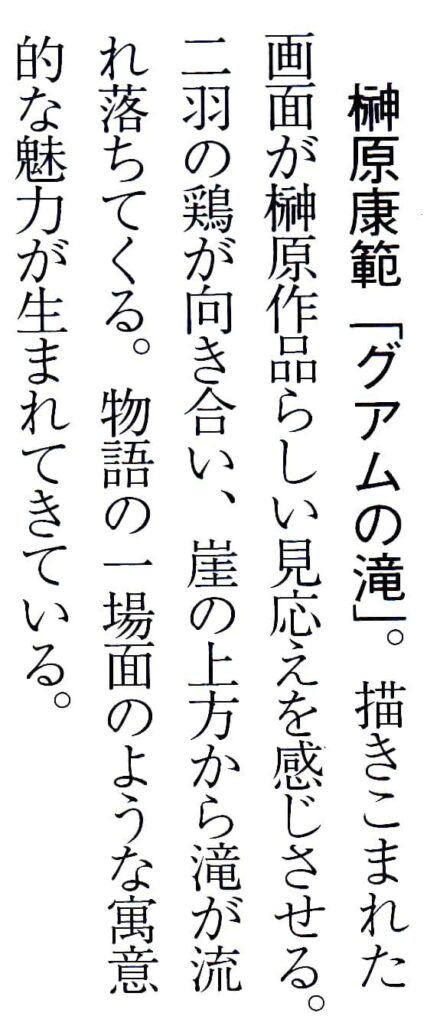
Sakakibara’s most recent project created some very interesting obstacles. When the president of Kwikspace, Peter Gill, donated a karabao statue to the Japan School in Mangi-lao, he asked Sakakibara to paint it. Moving from a two-dimensional canvas to a 3D sculpture proved very difficult, but Sakakibara has triumphed in the trial. Since he first uploaded pictures of the blank canvas to Facebook on Feb.
10, he has spent many afternoons at the Japanese school, using his hand as a pallet and working to give the animal life. In its current form, the animal seams to be growing out of its platform, into a wild jungle, that meets the sea on its back.
Perhaps this is a good way to describe his work. The animal that was ordinary in life, once painted by Sakakibara, becomes a creature of legend, worthy of being mythicized.
Story and photos by Amanda Pampuro
Exhibition; Creative Hands. in University of Guam Isla Center gallery
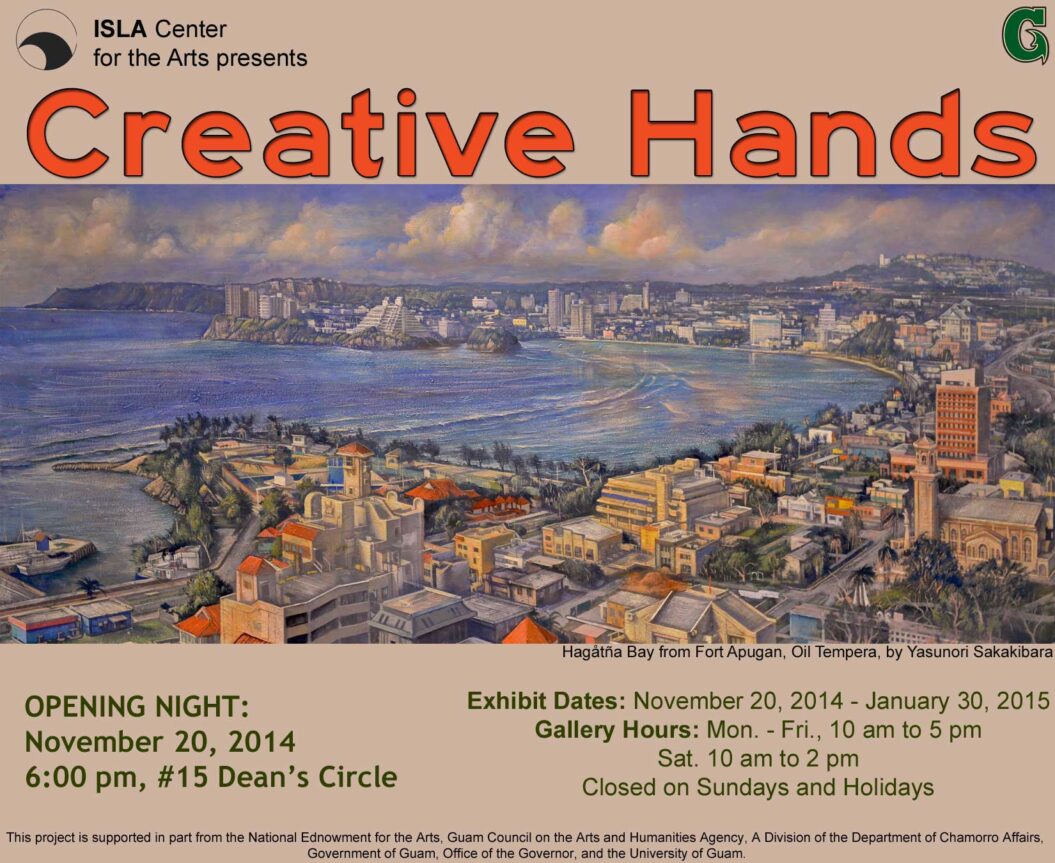
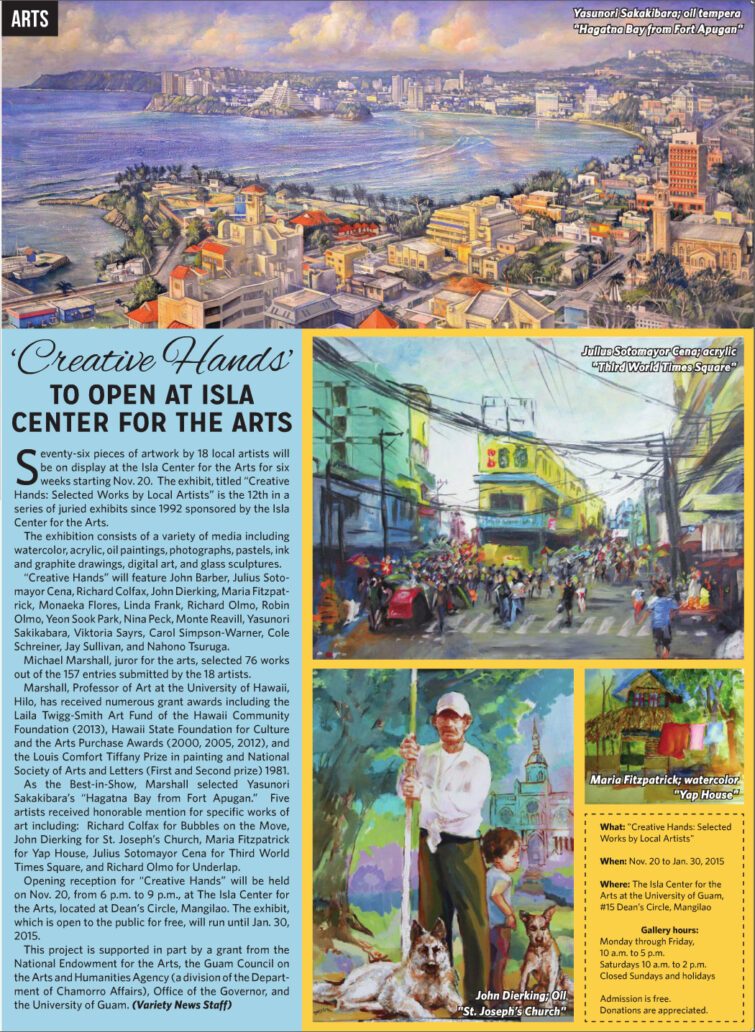
Island Time magazine
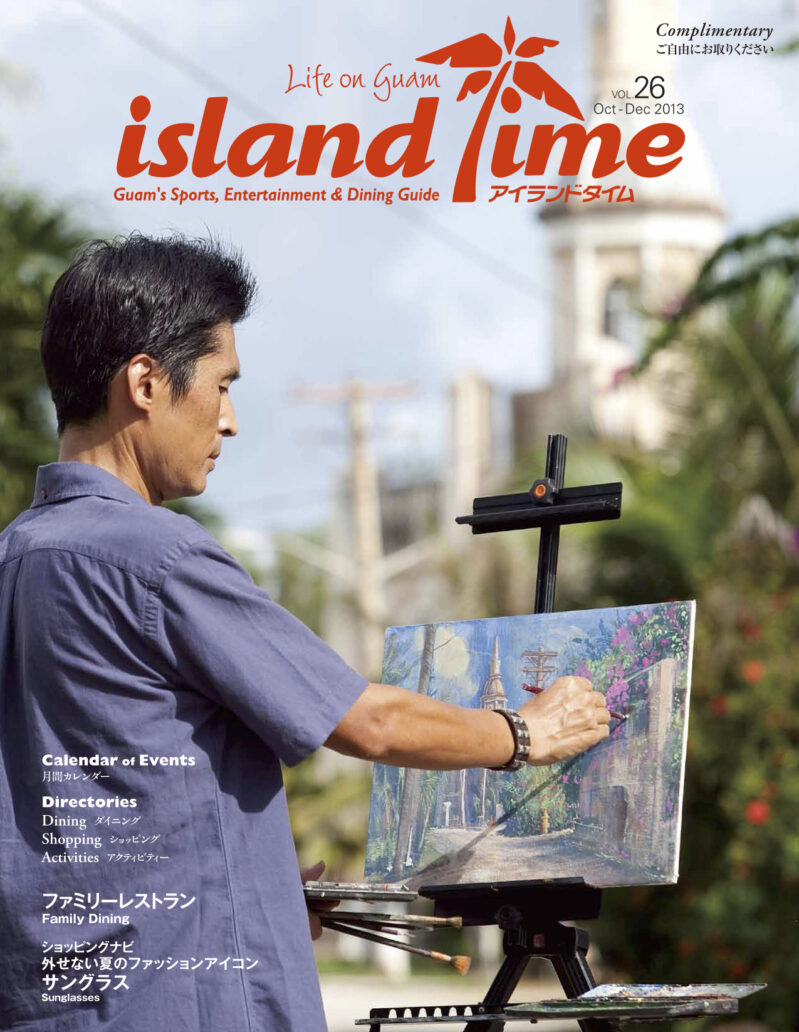
美術の窓 Art magazine ”BIjutsu no Mado
aado”